URL: https://multiphasesystems.online/mfs2026.2.010
DOI: https://doi.org/10.21662/mfs2026.2.010
Abstract
Flows of fluids with temperature-dependent viscosity are of considerable interest in fluid dynamics and heat transfer problems. Variations in
temperature may significantly affect the rheological properties of the medium, alter the flow structure, and lead to the development of
unsteady flow regimes. These effects are particularly important for channel flows with geometric irregularities such as cavities. In this
paper, the flow of a fluid with temperature-dependent viscosity in a channel with a heated cavity is investigated. The main objective of the
study is to analyze the dynamics of the flow rate and to identify the features of unsteady flow regimes. It is assumed that different types of
temperature dependence of viscosity may lead to different dynamic behavior of the flow rate and to different structures of phase trajectories.
Numerical simulations were performed in a three-dimensional formulation using the OpenFOAM software package. A modified simpleFoam
solver supplemented with the energy equation and a temperature-dependent viscosity model was used to solve the governing equations.
Two viscosity models were considered: a model with a monotonic decrease of viscosity with increasing temperature and a model with an
anomalous temperature dependence. The flow dynamics were analyzed using time series of the flow rate through the inlet cross section of
the channel. Phase trajectories in the (
Accepted: 19.05.2026
Published: 3.07.2026
Galikeeva RR. Numerical simulation of anomalously termoviscous fluid flow in a heated cavity. Multiphase Systems. 2026;21(2):51–58 (in Russian).
temperature-dependent viscosity;
cavity flow;
non-Newtonian fluids;
phase trajectories;
flow rate dynamics;
OpenFOAM
Article outline
This paper presents a numerical study of the flow of a fluid with temperature-dependent kinematic viscosity in a channel containing a heated cavity. The problem is motivated by the fact that viscosity variations caused by temperature changes may significantly affect the structure of the flow, the intensity of circulation inside the cavity, and the behavior of integral flow characteristics such as the flow rate. Such effects are especially important for thermoviscous and anomalously thermoviscous fluids, for which the viscosity is not constant but depends on the temperature field. In particular, the paper considers both a monotonic temperature dependence of viscosity and a non-monotonic dependence with a pronounced maximum.
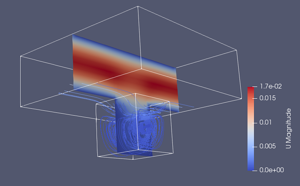
The main objective of the study is to determine how different models of temperature-dependent viscosity influence the unsteady dynamics of the flow rate and the corresponding phase trajectories in a three-dimensional channel flow with a heated cavity. The geometry consists of a straight channel with a cavity located on one of its walls. The cavity walls are heated, which leads to a non-uniform temperature distribution and, consequently, to spatial variations in the kinematic viscosity. These variations affect the velocity field and may change the interaction between the main flow in the channel and the recirculating flow inside the cavity.
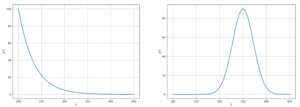
The numerical simulations are performed in a three-dimensional formulation using the OpenFOAM software package. The governing equations include the incompressibility condition, the momentum equations, and the energy equation. A modified version of the simpleFoam solver is used. The solver is supplemented with the temperature equation and with a viscosity model in which the kinematic viscosity is treated as a function of temperature. Two viscosity laws are analyzed. The first one describes a monotonic decrease of viscosity with increasing temperature. The second one describes an anomalous non-monotonic dependence, in which the viscosity increases up to a certain temperature range and then decreases.
The main quantity used to characterize the flow dynamics is the flow rate through the inlet cross section of the channel. The time series of the flow rate
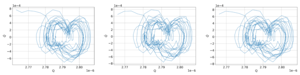
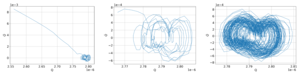
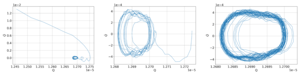
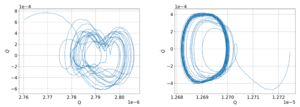
The results show that the dynamic behavior of the flow rate depends noticeably on the chosen model of temperature-dependent viscosity. In the case of monotonic viscosity variation, the flow rate exhibits more complex oscillatory behavior, which is reflected in the more complicated structure of the phase trajectories. For the anomalous non-monotonic viscosity model, the phase trajectories are more compact and more regular in the considered calculations. This indicates that the form of the viscosity-temperature relation can substantially affect the unsteady response of the flow system.
The study also emphasizes the importance of the three-dimensional formulation. A three-dimensional calculation makes it possible to analyze the spatial structure of the flow in the cavity region, including the formation of circulation zones and the interaction between the cavity flow and the main channel flow. Therefore, the analysis of the flow rate alone is not sufficient for a complete description of the system; it should be supplemented by the consideration of the spatial velocity field.
The obtained results demonstrate that temperature-dependent viscosity is an important factor controlling the dynamics of flows in channels with complex geometry. The use of phase trajectories provides a convenient tool for studying unsteady flow regimes and for comparing the influence of different viscosity models. The proposed approach may be useful for further numerical investigations of thermoviscous and anomalously thermoviscous fluids in channels, cavities, and other configurations where heat transfer and viscosity variations are strongly coupled.
References
- Ландау ЛД, Лифшиц ЕМ. Теоретическая физика. Т.6: Гидродинамика. 5-е издание. М.: Физматлит. 2001. 736 с. https://elibrary.ru/MVANJT
Landau LD, Lifshitz EM. Fluid Mechanics. Vol. 6. Course of Theoretical Physics. 2nd ed. Oxford: Butterworth-Heinemann. 1987. 539 p.
https://doi.org/10.1016/C2013-0-03799-1 - Лойцянский ЛГ. Механика жидкости и газа. 7-е издание, исправленное. М.: Дрофа. 2003. 840 с.
Loitsyanskii LG. (1966). Mechanics of Liquids and Gases. 7th ed. Pergamon Press. 1996. 816 p. https://doi.org/10.1016/C2013-0-05328-5 - Bird RB, Stewart WE, Lightfoot EN. Transport Phenomena. Rev. 2nd Ed. Wiley. 2002. 895+3 p.
- Ван-Дайк М. Альбом течений жидкостей и газов. М.: Мир, 1986. 184 с.
Van Dyke M. An Album of Fluid Motion. Stanford, CA: The Parabolic Press. 1982. 176 p. - Ferziger JH, Perić M. Computational Methods for Fluid Dynamics. 3rd rev. ed. Berlin: Springer. 2002. 154 p. https://doi.org/10.1007/978-3-642-56026-2
- Versteeg HK, Malalasekera W. An Introduction to Computational Fluid Dynamics. 2nd ed. Harlow: Pearson Education. 2007. 503 p.
- Ghia U, Ghia KN, Shin CT. High-Re solutions for incompressible flow using the Navier–Stokes equations and a multigrid method. Journal of Computational Physics. 1982;48(3):387–411. https://doi.org/10.1016/0021-9991(82)90058-4
- Shankar PN, Deshpande MD. Fluid mechanics in the driven cavity. Annual Review of Fluid Mechanics. 2000;32:93-136. https://doi.org/10.1146/annurev.fluid.32.1.93
- Weller H.G., Tabor G., Jasak H., Fureby C. A tensorial approach to computational continuum mechanics using object-oriented techniques // Computers in Physics. 1998.
- Payandeh M. Implementation of a Temperature Dependent Viscosity Model in OpenFOAM. Gothenburg: Chalmers University of Technology. 2012. 18 p. \url{https://www.tfd.chalmers.se/ hani/kurser/OS_CFD_2012/MostafaPayandeh/ViscosityModel
- Киреев ВН, Мухутдинова АА, Урманчеев СФ. О критических условиях теплообмена при течении жидкости с немонотонной зависимостью вязкости от температуры в кольцевом канале. Прикладная математика и механика. 2023;87(3):369–378. https://doi.org/10.31857/S0032823523030062
Kireev VN, Mukhutdinova AA, Urmancheev SF. On critical heat transfer conditions in the flow of a fluid with a non-monotonic temperature-dependent viscosity in an annular channel. Fluid Dynamics. 2023;58:1310–1317. https://doi.org/10.1134/S0015462823602036 - Urmancheev S, Kireev V. The Transient Flow of Liquid with Non-Monotonous Temperature Dependent Viscosity in a Plane Channel. AIP Conference Proceedings. 2017;1906(1):200009. https://doi.org/10.1063/1.5012485
- Мухутдинова АА. Задача о течении термовязкой жидкости в канале с каверной, содержащей охлаждающий элемент. Многофазные системы. 2024;19(4):146–151. https://doi.org/10.21662/mfs2024.4.022
Mukhutdinova AA. The problem of the flow of a thermoviscous fluid in a channel with a cavity containing a cooling element. Multiphase Systems. 2024;19(4):146–151 (in Russian).