URL: https://multiphasesystems.online/mfs2026.2.012
DOI: https://doi.org/10.21662/mfs2026.2.012
Abstract
This work presents a method for determining the volumetric distribution of electromagnetic field strength in a cylindrical chamber using multi-channel thermometry data of a dielectric medium. The relevance of the work is driven by the need for accurate characterization of electromagnetic field distribution in problems of microwave dielectric heating of high-viscosity oils and source rocks. The proposed approach combines the heat conduction equation with distributed heat sources and the formula for specific power absorption of an electromagnetic wave by a dielectric medium, enabling the solution of an inverse problem to reconstruct the spatial field distribution from temperature data. Two series of experiments were carried out: water was heated by a 2.45 GHz microwave field (800 W) in a 40 cm metallic pipe under two source configurations — lateral and radially symmetric. Water temperature in a 16-compartment container was measured with a thermal camera, and the readings were processed using digital image processing methods. The obtained data were used to reconstruct the spatial distribution of the squared electric field strength by coordinate-wise application of the Gauss-Newton method. It was found that the lateral configuration yields a highly irregular field pattern, with the exception of a periodic dependence on the angular coordinate, while the radially symmetric configuration produces a more ordered and symmetric distribution with a pronounced periodic dependence on the vertical coordinate. The proposed method enables three-dimensional mapping of the electromagnetic field and can be applied for parametric identification of thermophysical models of microwave heating in porous media.
Accepted: 16.06.2026
Published: 3.07.2026
Usmanov BA, Galeev RR, Musin AA, Zinnatullin RR. Determination of volumetric electromagnetic field distribution from dielectric heating data. Multiphase Systems. 2026;21(2):65–71 (in Russian).
microwave electromagnetic field;
dielectric heating;
3D printing;
digital image processing;
inverse problem
The study was supported by the Russian Science Foundation grant No. 22-11-20042.
Article outline
This paper presents the development and experimental validation of a method for reconstructing the volumetric distribution of electromagnetic field (EMF) strength in a cylindrical chamber from multi-channel thermometry data of a dielectric medium subjected to microwave irradiation.
The relevance of this work stems from the need for accurate characterization of the spatial EMF distribution in problems of dielectric heating of high-viscosity oils, natural bitumens, and source rocks. As conventional hydrocarbon reserves are progressively depleted and extraction shifts toward unconventional resources — in particular, the Bazhenov formation — electromagnetic heating methods are regarded as a promising alternative to steam-based techniques, which are limited by reservoir depth and low injectivity. The physical mechanism of heating involves dissipation of electromagnetic energy through orientational polarization of polar molecules in the medium — water, asphaltenes, and resins. When applied to source rocks, this leads not only to a reduction in fluid viscosity but also to kerogen pyrolysis with the formation of synthetic oil, as well as to thermal stresses that increase rock permeability. The accuracy of mathematical models of such processes critically depends on reliable knowledge of the EMF distribution inside the reservoir or process equipment.
The objective of this work is to develop a method for determining the volumetric distribution of the squared electric field strength from multi-channel thermometry data of a heated dielectric medium. The proposed method combines two relations: the heat conduction equation with distributed heat sources and the expression for the specific power absorbed by a dielectric medium from an electromagnetic wave, which is directly proportional to the squared electric field strength, the dielectric permittivity, the loss tangent, and the angular frequency of the field. Given spatially distributed temperature measurements in a medium with known properties under electromagnetic irradiation, the squared electric field strength can be calculated at each measurement point.
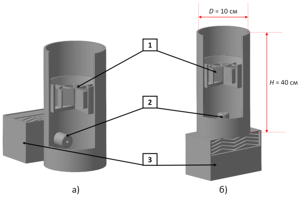
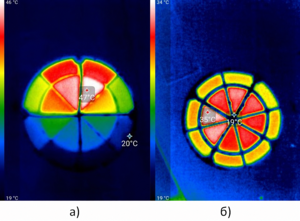
To implement the method, a dedicated experimental setup was developed. A 2.45 GHz magnetron operating at 800 W irradiated water placed in a 3D-printed, radio-transparent 16-compartment vessel with equal compartment volumes (4 mL each): the compartments provided spatially distributed temperature measurement points required for solving the inverse field reconstruction problem. The vessel was placed inside a 40 cm long metallic pipe with an inner diameter of 10 cm, acting as a waveguide; a metallic mesh at the upper end ensured the formation of a standing wave. The irradiation time was limited to 20 s, which justified a set of simplifying assumptions: heat conduction between adjacent compartments and changes in the dielectric properties of water upon heating were neglected — thereby reducing the inverse problem to a direct calculation of the squared EMF strength from the measured temperature rise in each compartment. Experiments were conducted in two source configurations: lateral (source at the side of the pipe) and radially symmetric (source below the pipe); measurements were taken at different distances from the source, yielding a set of cross-sectional “slices” of the volumetric field distribution. The water temperature in each compartment after irradiation was measured with a thermal imaging camera; quantitative processing of the thermograms employed digital image processing methods — conversion to grayscale, mapping against the camera’s color scale, and interpolation. The full volumetric distribution was reconstructed using the Gauss-Newton method through coordinate-wise optimization of the parameters of approximating functions, selected based on the physically observed periodicity of the field.
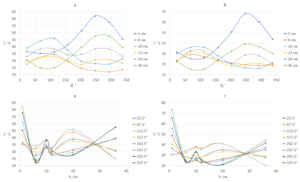
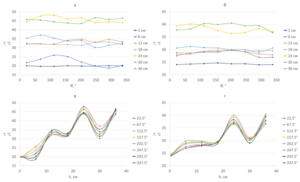
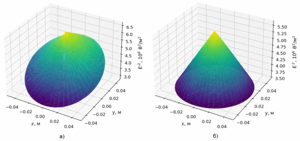
In the lateral configuration, the field distribution exhibits a pronounced periodic dependence on the angular coordinate. No clear periodicity along the vertical coordinate was detected, although the authors suggest it might emerge at greater distances from the source. In the radially symmetric configuration, the field is more ordered: angular symmetry is preserved, and a clear periodicity along the vertical coordinate is observed with a period close to the microwave wavelength (12.2 cm). The reconstructed three-dimensional distributions of the squared electric field strength show qualitative agreement with the expected physical behavior of the field in both configurations.
The proposed method enables three-dimensional mapping of the EMF distribution from standard thermal imaging data without placing sensors in the microwave irradiation zone, and is promising for parametric identification of thermophysical models of microwave dielectric heating in porous media.
References
- Мухаметова ЗС, Мусин АА, Зиннатуллин РР, Ковалева ЛА. Математическое моделирование электромагнитного воздействия на нефтематеринские горные породы с учетом фазовых переходов. Вестник Башкирского университета. 2021;26(2):274–280.
https://doi.org/10.33184/bulletin-bsu-2021.2.1
Mukhametova ZS, Musin AA, Zinnatullin RR, Kovaleva LA. Mathematical modeling of electromagnetic effects on source rocks with phase transitions. Bulletin of Bashkir University. 2021;26(2):274–280. (in Russian) - Ковалева ЛА, Зиннатуллин РР, Валеев МД, Миннигалимов РЗ, Фассахов РХ. Лабораторные исследования нагрева высоковязких нефтей в трубопроводах высокочастотным электромагнитным полем. Нефтяное хозяйство. 2019;(2):82–85.
https://doi.org/10.24887/0028-2448-2019-2-82-85
Kovaleva LA, Zinnatullin RR, Valeev MD, Minnigalimov RZ, Fassakhov RKh. Laboratory studies of high-viscosity oil heating in pipelines by high-frequency electromagnetic field. Oil Industry. 2019;(2):82–85. (in Russian) - Sahni A, Kumar M, Knapp RB. Electromagnetic Heating Methods for Heavy Oil Reservoirs. SPE Western Regional Meeting. Long Beach, California. 2000:SPE 62550. https://doi.org/10.2118/62550-MS
- Bera A, Babadagli T. Status of electromagnetic heating for enhanced heavy oil/bitumen recovery and future prospects: A review. Applied Energy. 2015;151:206–226. https://doi.org/10.1016/j.apenergy.2015.04.031
- Ерофеев АА, Митрушкин ДА, Меретин АС, et al. Моделирование термических методов разработки залежей баженовской свиты. Российская нефтегазовая техническая конференция SPE. Москва. 2016:SPE-182131-RU.
Erofeev AA, Mitrushkin DA, Meretin AS, et al. Simulation of Thermal Recovery Methods for Development of the Bazhenov Formation (Russian). SPE Russian Petroleum Technology Conference and Exhibition. Moscow. 2016:SPE-182131-RU. (in Russian) - Князева АГ, Маслов АЛ. Численное исследование влияния пористости на термическое разложение горючих сланцев при их подземном нагреве электромагнитным полем. Химическая физика и мезоскопия. 2016;18(2):206–214. https://elibrary.ru/wgcgrv
Knyazeva AG, Maslov AL. Numerical study of porosity effects on thermal decomposition of oil shales under underground electromagnetic heating. Chemical Physics and Mesoscopy. 2016;18(2):206–214. (in Russian) {https://elibrary.ru/wgcgrv} - Князева АГ, Маслов АЛ. Идентификация параметров модели термического разложения горючих сланцев. Химическая физика и мезоскопия. 2017;19(3):371–378. https://elibrary.ru/zrwqmh
Knyazeva AG, Maslov AL. Parameter identification of a thermal decomposition model for oil shales. Chemical Physics and Mesoscopy. 2017;19(3):371–378. (in Russian) - Martemyanov SM, Maslova AL. Two-Temperature Two-Dimensional Model of Underground Shale Heating by Electromagnetic Field. Advanced Materials Research. 2014;1040:620–624.
https://doi.org/10.4028/www.scientific.net/AMR.1040.620 - Давлетбаев АЯ, Ковалева ЛА, Насыров НМ. Исследование процессов тепломассопереноса в многослойной среде при нагнетании смешивающегося агента с одновременным электромагнитным воздействием. Теплофизика высоких температур. 2009;47(4):605–610.
https://elibrary.ru/kueqof
Davletbaev AYa, Kovaleva LA, Nasyrov NM. An Investigation of the Processes of Heat and Mass Transfer in a Multilayer Medium under Conditions of Injection of a Miscible Agent with Simultaneous Electromagnetic Stimulation. High Temperature. 2009;47(4):574–579. https://doi.org/10.1134/S0018151X09040166 - Mukhametshina A, Maximov M. Electromagnetic Heating of Heavy Oil and Bitumen: A Review of Experimental Studies and Field Applications. Journal of Petroleum Engineering. 2013:476519,
https://doi.org/10.1155/2013/476519 - Luan D, Tang J, Pedrow PD, Liu F, Tang Z. Analysis of electric field distribution within a microwave assisted thermal sterilization (MATS) system by computer simulation. Journal of Food Engineering. 2016;188:87–97. https://doi.org/10.1016/j.jfoodeng.2016.05.009
- Kaatze U. Complex permittivity of water as a function of frequency and temperature. Journal of Chemical and Engineering Data. 1989;34(4):371–374. https://doi.org/10.1021/je00058a001
- Gezahegn YA, Tang J, Sablani SS, et al. Dielectric properties of water relevant to microwave assisted thermal pasteurization and sterilization of packaged foods. Innovative Food Science \& Emerging Technologies. 2021;74:102837. https://doi.org/10.1016/j.ifset.2021.102837
- Насыров НМ, Низаева ИГ, Саяхов ФЛ. Математическое моделирование явлений тепломассопереноса в газогидратных залежах в высокочастотном электромагнитном поле. Прикладная механика и техническая физика. 1997;38(6):93–104. https://elibrary.ru/vbzonf
Nasyrov NM, Nizaeva IG, Sayakhov FL. Mathematical modeling of heat and mass transfer phenomena in gas hydrate deposits in a high-frequency electromagnetic field. Applied Mechanics and Technical Physics. 1997;38(6):93–104. (in Russian)