URL: https://multiphasesystems.online/mfs2026.3.021,en
DOI: https://doi.org/10.21662/mfs2026.3.021
Abstract
Linking biomedical terms to medical knowledge base concepts is an important step in medical text processing and is used in decision support systems, medical searches, and scientific publication analysis. Despite significant progress in the development of neural network methods, existing solutions still face challenges in processing multilingual data, the high variability of medical terminology, and the limited coverage of Russian-language terms in the UMLS knowledge base. The goal of this work is to develop a method for linking biomedical terms to UMLS concepts that ensures high quality for both English and Russian. To address this problem, we developed a method that includes preparing a UMLS knowledge base, constructing a FAISS index for quickly finding the closest candidates, using the SapBERT and BERGAMOT models to generate term embeddings, automatically translating Russian-language mentions, re-ranking the identified candidates based on semantic and lexical features, and aggregating the results at the UMLS concept level. An experimental evaluation was conducted on the official BioNNE-L dataset, containing English, Russian, and multilingual tracks. The proposed method demonstrated competitive results on all three tracks: Russian, English, and multilingual. An error analysis revealed that the main reasons for the poor quality were insufficient coverage of Russian-language terminology in UMLS, homonymy of medical terms, and difficulty processing abbreviations. The obtained results confirm the effectiveness of the proposed method for linking biomedical terms to UMLS concepts. The developedapproach can be used in the creation of medical information systems and decision support systems, and also serve as a basis for further research in the field of multilingual biomedical entity linking and medical terminology normalization.
Accepted: 16.09.2026
Published: 30.09.2026
Kuzmin IL. Automatic Methods for Linking Texts to a Knowledge Base Using Neural Networks. Multiphase Systems. 2026;21(3):137–145 (in Russian).
biomedical entity binding;
concepts;
UMLS;
CUI;
encoder;
embedding;
SAPBERT;
BERGAMOT;
FAISS
Article outline
The development of electronic medical records, clinical information systems, and digital libraries has resulted in the creation of large volumes of medical texts, much of which are presented in an unstructured form. Automatic analysis of such information requires not only detecting references to diseases, medications, anatomical structures, and other medical entities, but also correctly interpreting them. This raises the challenge of linking biomedical terms to a knowledge base, which is essential for building medical information systems, analyzing scientific publications, searching for clinical information, and supporting medical decision-making systems. The most widely used knowledge base for standardizing medical terminology is the Unified Medical Language System (UMLS), which comprises millions of concepts and tens of millions of synonyms. However, the large vocabulary, the presence of numerous synonyms, the homonymy of medical terms, and the limited coverage of the Russian language significantly complicate the task of automatic entity linking.
The goal of this work is to develop a method for linking biomedical terms to UMLS concepts, ensuring high-quality processing of both English- and Russian-language medical texts. To achieve this goal, an approach combining semantic search, automatic translation, and additional re-ranking of identified candidates is proposed.
The BioNNE-L dataset, prepared as part of the BioASQ 2025 competition and based on the NEREL-BIO corpus, was used as the experimental base. The dataset includes three tracks: English, Russian, and multilingual, allowing us to evaluate the method's performance in both monolingual and multilingual problem settings.
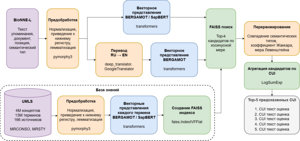
The proposed method consists of several sequential steps. During the knowledge base preparation stage, terms, concepts, and their semantic types are extracted from UMLS. Embeddings are then pre-calculated for all terms and a FAISS index is constructed, enabling rapid search for the closest candidates among millions of records. To obtain vector representations, specialized models are used: SapBERT for English and BERGAMOT for Russian and multilingual tracks. When processing Russian-language terms, automatic translation into English is additionally performed, allowing for more comprehensive English-language coverage of UMLS. After searching for the closest candidates, they are re-ranked using cosine similarity, Jaccard coefficient, Levenshtein distance, and the semantic type of the entity. The final step is aggregation of the found terms by UMLS concept identifiers using the LogSumExp function.
Experimental evaluation was conducted using the Accuracy@1, Accuracy@5, and Mean Reciprocal Rank metrics. The proposed method demonstrated competitive results in all three competition tracks. Accuracy@1 was 0.68 for the multilingual track, 0.69 for English, and 0.71 for Russian. These results are comparable with the best solutions submitted by BioNNE-L competition participants.
An error analysis was also conducted to identify the main causes of the decline in linking quality. For the Russian language, the greatest challenges stem from the limited coverage of UMLS terms in Russian, meaning the correct concept is not always present among the returned candidates. For English, the main problem is the homonymy of medical terms and abbreviations, where a single mention may correspond to several different concepts. A separate analysis revealed that medical abbreviations represent the most challenging category, especially when there is no exact match with a term in the knowledge base.
The results confirm the effectiveness of the proposed approach for linking biomedical terms to UMLS concepts. The developed method can be used in the creation of medical information systems and medical text analysis systems. Promising areas for further work include expanding the Russian-language portion of the knowledge base and taking into account the context of the mention when selecting the most appropriate concept.
References
- Sakhovskiy A, Loukachevitch N, Tutubalina E. Overview of the BioASQ BioNNE-L Task on Biomedical Nested Entity Linking in CLEF 2025. In: Faggioli G, Ferro N, Rosso P, Spina D, eds. CLEF 2025 Working Notes. CEUR Workshop Proceedings. 2025;4038:41–50. https://ceur-ws.org/Vol-4038/paper_3.pdf
- Bodenreider O. The Unified Medical Language System (UMLS): integrating biomedical terminology. Nucleic Acids Res. 2004;32(suppl_1):D267–D270. https://doi.org/10.1093/nar/gkh061
- Liu F, Vuli\'c I, Korhonen A et al. Learning domain-specialised representations for cross-lingual biomedical entity linking. In: Proceedings of ACL-IJCNLP 2021 (Volume 2: Short Papers). 2021:565–574. https://doi.org/10.18653/v1/2021.acl-short.72
- Sakhovskiy A, Semenova N, Kadurin A, Tutubalina E. Biomedical Entity Representation with Graph-Augmented Multi-Objective Transformer. In: Findings of the Association for Computational Linguistics: NAACL 2024. 2024:4626–4643. https://doi.org/10.18653/v1/2024.findings-naacl.288
- Loukachevitch N, Manandhar S, Baral E et al. NEREL-BIO: a dataset of biomedical abstracts annotated with nested named entities. Bioinformatics. 2023;39(4):btad161. https://doi.org/10.1093/bioinformatics/btad161
- Jin Q, Kim W, Chen Q et al. MedCPT: Contrastive pre-trained transformers with large-scale PubMed search logs for zero-shot biomedical information retrieval. Bioinformatics. 2023;39(11):btad651. https://doi.org/10.1093/bioinformatics/btad651
- Pe\ na Gnecco D, Serrano J, Puertas E, Mart\'inez Santos JC. Hybrid Re-ranking for Biomedical Entity Linking using SapBERT Embeddings: A High-Performance System for BioNNE-L 2025-1. In: Faggioli G, Ferro N, Rosso P, Spina D, eds. CLEF 2025 Working Notes. CEUR Workshop Proceedings. 2025;4038:497–508. https://ceur-ws.org/Vol-4038/paper_35.pdf
- Liu Y, Zhu S. LYX_DMIIP_FDU At BioASQ 2025: Utilizing BERT Embeddings For Biomedical Text Mining. In: Faggioli G, Ferro N, Rosso P, Spina D, eds. CLEF 2025 Working Notes. CEUR Workshop Proceedings. 2025;4038:420–432. https://ceur-ws.org/Vol-4038/paper_29.pdf
- Burlova A. Navigating Partial UMLS Terminology: GAT Embeddings and Confidence Analysis for Multilingual Concept Linking. In: Faggioli G, Ferro N, Rosso P, Spina D, eds. CLEF 2025 Working Notes. CEUR Workshop Proceedings. 2025;4038:198–205. https://ceur-ws.org/Vol-4038/paper_11.pdf
- Douze M, Guzhva A, Deng C et al. The Faiss Library. IEEE Trans Big Data. 2026;12(2):346–361. https://doi.org/10.1109/TBDATA.2025.3618474
- Li C, Zheng X, Liu S. BIBERT-Pipe on Biomedical Nested Named Entity Linking at BioASQ 2025. In: Faggioli G, Ferro N, Rosso P, Spina D, eds. CLEF 2025 Working Notes. CEUR Workshop Proceedings. 2025;4038:411–419. https://ceur-ws.org/Vol-4038/paper_28.pdf
- Lain AD, Lee C, Doneva SE et al. Multilingual and Nested Biomedical Named Entity Normalization via Candidate Retrieval and Lightweight Large Language Model Disambiguation. In: Faggioli G, Ferro N, Rosso P, Spina D, eds. CLEF 2025 Working Notes. CEUR Workshop Proceedings. 2025;4038:383–392. https://ceur-ws.org/Vol-4038/paper_26.pdf