URL: https://multiphasesystems.online/mfs2026.3.019,en
DOI: https://doi.org/10.21662/mfs2026.3.019
Abstract
This study examines the dimensionless electric field distribution in a two-dimensional model of the interelectrode region during
electrochemical machining (ECM). The investigation was prompted by damage observed on the lateral surfaces of titanium workpieces
outside the intended machining zone. The aim is to assess edge effects and compare electric field strengths within the working gap and in
adjacent regions of the electrolyte. The model geometry is defined independently of physical dimensions, with the ratio of the
interelectrode gap height to the vertical dimension of the electrode serving as a key parameter. The electrolyte is treated as an unbounded
medium, and the potential difference between the electrodes is specified as a model parameter. Edge rounding radii are not explicitly
prescribed. The analysis is based on finite element simulations performed in ELCUT. The results are presented as the dimensionless electric
field magnitude
Accepted: 17.09.2026
Published: 30.09.2026
Sokolova AA, Sherykhalina NM, Urakov AR, Shaimardanova ER. Numerical Simulation of Electric Field Distribution in Electrochemical Machining of Titanium Alloys. Multiphase Systems. 2026;21(3):123–128 (in Russian).
electrochemical machining;
titanium alloys;
finite element method;
electric field strength;
stray dissolution;
passivation
The investigation is funded by the Russian Science Foundation, Grant No. 25-99-33001.
Article outline
Titanium alloys are extensively utilized in aerospace and medical industries due to their exceptional specific strength and corrosion resistance. Electrochemical machining (ECM) is a promising non-contact method for shaping these materials. The process relies on the anodic dissolution of the workpiece within an interelectrode gap. However, ECM of titanium alloys presents a specific challenge: the formation of a natural passive oxide film. While this film protects the material, localized surface defects, such as pits and pitting corrosion, are frequently observed on the side surfaces of the workpiece, outside the direct machining zone. These defects are caused by the stray spread of the electric field beyond the working gap. Local concentrations of electric field strength on the side facets can exceed the passivation threshold of the titanium alloy, triggering non-uniform anodic dissolution. This phenomenon reduces machining accuracy and creates stress concentrators, compromising component fatigue life.
The primary objective of this study is to identify the zones of electric field concentration outside the active interelectrode gap and to quantitatively assess the risk of stray dissolution on the side surfaces of the titanium anode. By mapping the electric field distribution, the research aims to provide a mathematical basis for eliminating hidden surface defects.
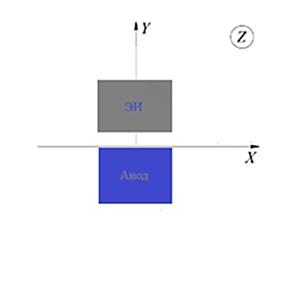
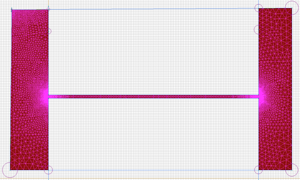
To achieve these objectives, a two-dimensional mathematical model of the electrochemical cell cross-section was developed. The theoretical foundation relies on Faraday and Ohm laws, where the electrostatic potential distribution is described by Laplace equation. The calculation of the electric field strength was performed using the Finite Element Method implemented in the ELCUT software suite. The computational domain was discretized using adaptive triangulation, which automatically refines the mesh in areas of expected high gradients, such as corners and the narrow interelectrode gap, minimizing numerical differentiation errors. Boundary conditions included fixed potentials on the working electrodes, electrical insulation on the outer boundaries, and continuity conditions at the metal-electrolyte interfaces.
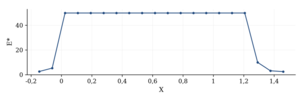
The numerical simulation revealed distinct patterns of electric field distribution. In the active working gap, the field is highly uniform (approximately 50.0 V/m), ensuring stable material removal. However, on the side surfaces of the anode, the field strength drops to between 0.1 and 10.0 V/m but does not reach zero, indicating a stray electric field. Crucially, the simulation identified severe local peaks of electric field strength in the corner junctions of the workpiece, reaching values up to 9.9 V/m. Analysis demonstrates that for titanium alloys in certain electrolytes, electric fields in the range of 3 to 8 V/m are sufficient to locally rupture the passive oxide film. The modeled peaks significantly exceed this threshold, providing a clear physical explanation for the experimentally observed pitting at angular junctions.
These findings shift the paradigm from empirical trial and error in selecting insulation screens to targeted, mathematically driven tooling design. Engineers can design custom cathode geometries and shielding elements to strictly confine current lines. Furthermore, the quantitative data can be integrated into modern CAM systems for automatic tool-electrode shape correction. The study also highlights the potential of combining electrostatic modeling with pulsed ECM regimes, where inter-pulse pauses allow the passive film to recover on vulnerable side surfaces. Future research will expand this two-dimensional model into a fully coupled three-dimensional multiphase simulation, incorporating the hydrodynamics of the two-phase flow to better understand local passivation layer breakdown under dynamic conditions.
References
- Нехорошев МВ, Проничев НД, Смирнов ГВ. Автоматизированное профилирование электродов-инструментов при импульсной электрохимической обработке. Вестник Самарского университета. Аэрокосмическая техника, технологии и машиностроение. 2014;13(5-3):158–166.https://doi.org/10.18287/1998-6629-2014-0-5-3(47)-158-166
Nekhoroshev MV, Pronichev ND, Smirnov GV. Automated profiling of tool electrodes in pulsed electrochemical machining. Vestnik of Samara University. Aerospace and Mechanical Engineering. 2014;13(5-3):158–166. (in Russian) - Нехорошев МВ, Проничев НД, Смирнов ГВ. Методика создания трёхмерных твёрдотельных моделей электродов-инструментов для импульсной электрохимической обработки деталей газотурбинных двигателей в CAD-системе с их параметрической связью с программным модулем профилирования. Вестник Самарского университета. Аэрокосмическая техника, технологии и машиностроение. 2015;14(3-2):418–424. https://doi.org/10.18287/2412-7329-2015-14-3-418-424
Nekhoroshev MV, Pronichev ND, Smirnov GV. Procedure for creating three-dimensional solid models of tool electrodes for pulsed electrochemical machining of gas turbine engine parts in a CAD system with parametric coupling to a profiling module. Vestnik of Samara University. Aerospace and Mechanical Engineering. 2015;14(3-2):418–424.(in Russian). - Смирнов ГВ. Исследование наводораживания при окончательной импульсной электрохимической обработке пера лопаток компрессора из титанового сплава ВТ9. Вестник Самарского университета. Аэрокосмическая техника, технологии и машиностроение. 2008;7(3):66–72. https://doi.org/10.18287/2541-7533-2008-0-3(16)-66-72
Smirnov GV. Investigation of hydrogen absorption during final pulsed electrochemical machining of compressor blade airfoils made of VT9 titanium alloy. Vestnik of Samara University. Aerospace and Mechanical Engineering. 2008;7(3):66–72. (in Russian). - Дресвянников АФ, Салемгараева ЛР, Чонг ФТ. Особенности анодного поведения комбинированного электрода «железо–титан» в галогенид-содержащих электролитах. Физикохимия поверхности и защита материалов. 2020;56(3):317–322. https://doi.org/10.31857/S0044185620030134
Dresvyannikov AF, Salemgaraeva LR, Chong FT. Features of the Anode Behavior of the Combined Iron–titanium Electrode in Halide-Containing Electrolytes. Protection of Metals and Physical Chemistry of Surfaces. 2020;56(3):596–602. https://doi.org/10.1134/S2070205120030132 - Кошев АН, Варенцов ВК. Краевые условия для дифференциальных уравнений, описывающих электрохимические процессы в реакторах с проточными трехмерными электродами. Математическое моделирование. 2014;26(2):11–23. https://elibrary.ru/rxprmp
Koshev AN, Varentsov VK. Modeling Boundary Conditions for the Differential Equations, Describing Electrochemical Processes in the Reactors With the Flow Three-Dimensional Electrodes. Mathematical Models and Computer Simulations. 2014;26(2):11–23. (in Russian) - Миназетдинов НМ. Гидродинамическая модель явления «струйности» при электрохимической обработке металлов. Прикладная математика и механика. 2021;85(5):664–674. https://doi.org/10.31857/S0032823521050064
Minazetdinov NM. A hydrodynamic model of the striation phenomenon in electrochemical machining of metals. Journal of Applied Mathematics and Mechanics. 2021;85(5):664–674. (in Russian). - Миназетдинов НМ. Электрохимическая обработка металлов неподвижным катодом-инструментом. Вестник Российского нового университета. Серия «Сложные системы: модели, анализ и управление». 2024;(2):3–9. https://elibrary.ru/kwqnxr
Minazetdinov NM. Electrochemical Machining of Metals With Motionless Cathode-Tools. Vestnik of the Russian New University. Series ”Complex Systems: models, analysis and management“. 2024;(2):3–9. (in Russian).