URL: https://multiphasesystems.online/mfs2026.2.013,en
DOI: https://doi.org/10.21662/mfs2026.2.013
Abstract
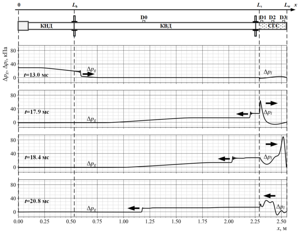
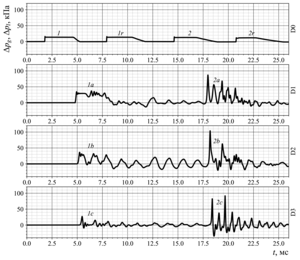
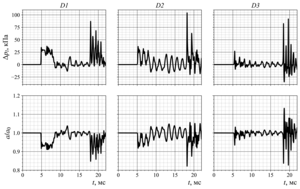
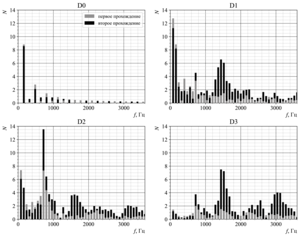
The initial-boundary value problem of the evolution of a wave pulse in a shock tube initiated by discontinuity decay is solved numerically using the control volume method. Since experiments studying shock-wave pulses are conducted in shock tube setups, the computational domain is chosen to correspond to similar setups. The discontinuity decay process is modeled, where the pressure difference in the high- and low-pressure chambers causes the diaphragm to rupture and a shock-wave pulse to form. The model also includes a domain corresponding to the gas-liquid section, which in this case contains a bubble-saturated liquid. The low-pressure chamber and the gas-liquid section are equipped with pressure sensors. A problem formulation is developed, including the conservation equations for mass, momentum, and energy. The problem formulation is written for the gas phase and the bubbly liquid. Pressure diagrams are constructed to study the spatial pressure distribution in the described domain. The data obtained by the sensors are calculated, and pressure oscillograms are plotted. The change in bubble radius over time is examined, and a relationship between this change and sudden pressure surges in a bubbly liquid is identified. A case of repeated reflection of a shock wave pulse from a bubbly liquid and an increase in its amplitude in a gas-liquid mixture is considered. An increase in amplitude is observed upon repeated passage of the shock wave pulse through the bubbly liquid. Using a discrete Fourier transform, the pulse spectrum in the bubbly liquid is obtained. The frequency spectrum for the first and second passages of the wave in the bubbly liquid is compared. Frequencies that contribute most to the frequency spectrum are identified.
Accepted: 22.06.2026
Published: 3.07.2026
Rodionov AS, Zakirova ER. Numerical solution of the initial boundary value problem of the repeated impact of a shock pulse on a bubbly liquid. Multiphase Systems. 2026;21(2):72–80 (in Russian).
boundary value problem;
system of partial differential equations;
shock tube;
fracture decay;
bubbly fluid;
numerical method;
numerical calculations
The research was carried out at the expense of a grant from the Russian Science Foundation no. 24-11-00274, https://rscf.ru/project/24-11- 00274/
Article outline
This article examines the initial boundary value problem of the evolution of a wave pulse in a shock tube initiated by fracture decay. It is solved numerically using the control volume method. The case of repeated reflection of a shock wave pulse from a bubbly liquid and its amplitude increase in a gas-liquid mixture is considered. An increase in amplitude is observed upon repeated passage of the shock wave pulse through the bubbly liquid. Using a discrete Fourier transform, the pulse spectrum in the bubbly liquid is obtained. The frequency spectra for the first and second passages of the wave in the bubbly liquid are compared.
Interest in studying wave propagation in bubble-saturated liquids is associated with the application of research results in seismology, the design of protective structures,
for example, in the design of bubble curtains, and the use of hydraulic fracturing. Formulating such problems necessitates solving initial boundary value problems consisting of a
system of partial differential equations. Experiments to study the dynamics of the shock wave pulses (SWP) are carried out in a shock tube setup, so the problem of repeated pulse
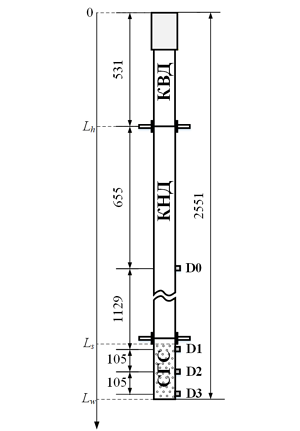
reflection from a layer of bubbly liquid will be studied for the scheme of a typical shock tube. The shock tube includes a high-pressure chamber (HPC) in the region
0 ⩽
The problem described above is reduced to an initial boundary value problem. The problem statement includes generally accepted assumptions used in describing the gas phase and bubbly liquids; the gas is assumed to be calorically perfect. The problem is solved numerically using the control volume method.
This work utilizes the Fourier transform, which represents a signal as a sum of harmonic oscillations with different frequencies, amplitudes, and phases. This allows for the study of the contribution of different frequencies to the overall signal. Therefore, the calculation results are used to analyze the frequency spectrum obtained using the discrete Fourier transform.
This article examines the initial boundary value problem of the impact of a shock wave pulse on a bubbly liquid and the excitation of a pressure wave in it. Using the control volume method, the following assertion was established: repeated passage of a shock wave pulse through a layer of liquid saturated with bubbles can cause a sharp, short-term increase in pressure amplitude lasting up to 0.5 ms. This increase in amplitude can be more than seven times that of the incident pulse. The frequency spectrum of the signal during repeated passage exhibits higher frequencies (up to 6000 Hz) compared to the first passage, where frequencies up to 1000 Hz are predominant.
References
- Зайцев ВЮ, Колпаков АБ, Назаров ВЕ. Детектирование акустических импульсов в речном песке. Эксперимент. Акустический журнал. 1999;45(2):235–241.
https://www.akzh.ru/pdf/1999_2_235-241.pdf
Zaytsev VYu, Kolpakov AB, Nazarov VE. Detection of Acoustic Pulses in River Sand. Experiment. Akusticheskij zhurnal. 1999;45(2):235–241. (in Russian) - Дучков АД, Дучков АА, Дугаров ГА, Дробчик АН. Скорости ультразвуковых волн в песчаных образцах, содержащих воду, лёд или гидраты метана и тетрагидрофурана (лабораторные измерения). Доклады Академии наук. 2018;478(1):94–99.
https://doi.org/10.7868/S086956521801019X
Duchkov AD, Duchkov AA, Dugarov GA. et al. Velocities of Ultrasonic Waves in Sand Samples Containing Water, Ice, or Methane and Tetrahydrofuran Hydrates (Laboratory Measurements). Dokl. Earth. Sc. 2018;478:74–78 (2018). https://doi.org/10.1134/S1028334X18010014 - Gubaidullin AA, Pyatkova AV. Specificities of Heat Transfer in a Vibrating Cylindrical Cavity at the Transition of the Exposure Frequency Through Resonance. Lobachevskii J. Math. 2022;43:1069–1075.
https://doi.org/10.1134/S1995080222080121 - Сычев АИ. Сильные ударные волны в пузырьковых средах. Журнал технической физики. 2010;80(6):31–35. https://elibrary.ru/rctsxz
Sychev AI. Intense shock waves in bubble media. Technical Physics. 2010;55(6):783–788. https://doi.org/10.1134/S1063784210060058 - Суров ВС. К расчёту ударно-волновых процессов в пузырьковых жидкостях. Журнал технической физики. 1998;68(11):12–19.
https://elibrary.ru/rynyub
Surov VS. Calculating shock-wave processes in bubbly liquids. Tech. Phys. 1998;43:1280–1287. https://doi.org/10.1134/1.1259184 - Галимзянов МН, Лепихин СА, Чиглинцев ИА. Распространение нелинейных волн в каналах переменного сечения, сопровождаемое образованием гидрата газа. Вестн. СамГУ. Естественнонаучн. сер. 2012;(3/1(94)):103–115. https://elibrary.ru/pjfbzt
Galimzyanov MN, Lepikhin SA, Chiglintsev IA. Propagation of Nonlinear Waves in Channels With Variable Cross-Section, Led to the Gas Hydrate Formation. Vestnik of Samara University. Natural Science Series. 2012;(3/1(94)):103–115. (in Russian) - Кедринский ВК, Шокин ЮИ, Вшивков ВА, Дудникова ГИ. Лазарева ГГ. Генерация ударных волн в жидкости сферическими пузырьковыми кластерами. Доклады Академии наук. 2001;381(6):773–776.
https://elibrary.ru/mjuaby
Kedrinskiǐ VK, Shokin YuI, Vshivkov VA, Dudnikova GI, Lazareva GG. Generation of shock waves by spherical bubble clusters in a liquid. Doklady Physics. 2001;46(12):856–859. https://doi.org/10.1134/1.1433529 - Авдеев КА, Аксенов ВС, Борисов АА, Тухватуллина РР, Фролов СМ, Фролов ФС. Численное моделирование воздействия ударной волны на пузырьковую среду. Горение и взрыв. 2015;8(2):45–56.
https://elibrary.ru/vqzwlj
Avdeyev KA, Aksenov VS, Borisov AA, Tukhvatullina RR, Frolov SM, Frolov FS. Numerical Modeling of the Impact of Shockwave on Bubbly Environment. Combustion and explosion – Gorenie i vzryv. 2015;8(2):45–56. (in Russian) - Hemmi K, Kanagawa T. Impact of a bubble-bubble interaction on nonlinear acoustic properties of pressure waves in a non-dilute bubbly liquid. Results in Engineering. 2025;25:103752.
https://doi.org/10.1016/j.rineng.2024.103752 - Пригожих ВА, Дамдинов ББ. Моделирование распространения звука в жидкости с пузырьками воздуха. Вестник Бурятского государственного университета. Химия. Физика. 2025;(1):49–55.
https://doi.org/10.18101/2306-2363-2025-1-49-55
Prigozhikh VA, Damdinov BB. Modeling the Propagation of Sound in a Liquid Containing Air Bubbles. BSU bulletin. Chemistry. Physics. 2025;(1):49–55. (in Russian) - Галимзянов МН, Болотнова РХ, Агишева УО, Бузина ВА. Гидродинамика ударных волн и вскипающих потоков в пузырьковых жидкостях. Вестник Нижегородского университета им. Н.И. Лобачевского. 2011;(4-‑3):700–701. https://elibrary.ru/rufbmj
Galimzyanov MN, Bolotnova RKh, Agisheva UO, Buzina VA. Hydrodynamics of Shock Waves and Boiling Flows in Bubbly Liquids. Vestnik of Lobachevsky University of Nizhni Novgorod. 2011;(4-‑3):700–701. (in Russian) - Gimaltdinov IK, Rodionov AS, Valiakhmetova OYu. Initial-boundary Value Problem of the Transfer of a Shock Impulse Falling from a Gas into a Powdered Medium Saturated with a Gas–Liquid Mixture. Lobachevskii J. Math. 2025;46:3298–3306.
https://doi.org/10.1134/S1995080225608793 - Губайдуллин ДА, Никифоров АА. Акустические волны в вязкоупругих пузырьковых средах. Теплофизика высоких температур. 2019;57(1):150–153. https://doi.org/10.1134/S0040364419010290
Gubaidullin DA, Nikiforov AA. Acoustic Waves in Viscoelastic Bubbly Media. High Temperature. 2019;57(1):133–136.
https://doi.org/10.1134/S0018151X1806010X - Нигматулин РИ, Губайдуллин АА, Берегова ОШ. Метод сверхсильного резонансного сжатия пузырьковой жидкости умеренным непериодическим воздействием. Доклады Академии наук. https://elibrary.ru/xlbmgh
Nigmatulin RI, Gubaǐdullin AA, Beregova OSh. Method of resonance overcompression in a bubble liquid by a moderate aperiodic action. Doklady Physics. 2000;45(10):539–542. https://doi.org/10.1134/1.1327326 - Губин СА, Сверчков АМ, Сумской СИ. Моделирование генерации и распространения ударных волн и волн сжатия в пузырьковых средах. Горение и взрыв. 2021;14(1):47–58.
https://doi.org/10.30826/CE21140106
Gubin SA, Sverchkov AM, Sumskoy SI. Simulation of Generation and Propagation of Shock/compression Waves in Bubbly Mediah. Combustion and explosion – Gorenie i vzryv. 2021;14(1):47–58. (in Russian) - Delale C, Nas S, Tryggvason G. Direct numerical simulations of shock propagation in bubbly liquids. Physics of Fluids. 2005;17:121705.
https://doi.org/10.1063/1.2158431 - Ахметов АТ, Гималтдинов ИК, Азаматов МА, Мухаметзянов АФ, Богданов ДР. Зондирование водогазонасыщенных насыпных сред переотраженными волнами непосредственно после воздействия ударной волны. Письма в Журнал технической физики. 2022;48(1):23–26. https://doi.org/10.21883/PJTF.2022.01.51874.18834
Akhmetov AT, Gimaltdinov IK, Azamatov MA, Mukhametzyanov AF, Bogdanov DR. Sounding of Water‑Gas‑Saturated Bulk Media by Rereflected Waves Immediately after the Impact of a Shock Wave. Technical Physics Letters. 2022;48:97–102.
https://doi.org/10.1134/s1063785022040022 - Нигматулин РИ. Динамика многофазных сред. Часть 1. М.: Наука; 1987. 464 с.
Nigmatulin RI. Dynamics of Multiphase Media. Vol. 1. Hemisphere, N.Y.; 1990. 532 p. - Патанкар С. Численные методы решения задач теплообмена и динамики жидкости. М.: Энергоатомиздат. 1984; 152 с.
Patankar SV. Numerical Heat Transfer and Fluid Flow. Hemisphere. 1980; 214 p.