URL: https://multiphasesystems.online/mfs2026.2.011
DOI: https://doi.org/10.21662/mfs2026.2.011
Abstract
The paper examines how the choice of the type of boundary conditions in a mathematical model affects the results of interpretation of data from well tests with a stepwise change in bottom-hole pressure, analyzed by the method of constructing an indicator diagram(ID). This task is especially relevant for low-permeability reservoirs with fractured hydraulic fracturing. The purpose of the work is to determine the features of the application of the ID method under different conditions at the boundaries of the reservoir and to select the optimal duration of the stages of the well test, in order to increase the reliability of the interpretation. When modeling the flow of liquid into a producing well with a fractured hydraulic fracturing, seven stages of well operation were calculated at a bottom-hole pressure from 5 to 6.5 MPa and the duration of each stage from 5 to 30 days. The results showed that if constant pressure is maintained at the reservoir boundary, the duration of the modes has almost no effect on the results of the interpretation of the well test by the ID method. In a reservoir with an impenetrable boundary, an increase in the duration of the stages leads to a decrease in the reliability of the approximation of the pressure dependence on the inflow due to the influence of the boundaries of the model. To eliminate the effect of boundaries for wells in formations with impenetrable boundaries, it is recommended to choose the minimum duration of the stages at which the flow of liquid into the well becomes steady. These conclusions are useful when planning a stepwise pressure change in a well.
Accepted: 15.06.2026
Published: 3.07.2026
Timershaehova AYa, Gubaidullin MR, Davletbaev AYa, Mukhametova ZS. Modelling of well tests with stepwise pressure changes in low-permeability reservoirs with a hydraulic fracture. Multiphase Systems. 2026;21(2):59–64 (in Russian).
well test;
indicator diagram;
boundary conditions;
reservoir pressure;
radius of study;
productivity coefficient
Article outline
Well testing (well testing) is a key tool for monitoring reservoir development. It allows evaluation of the flow properties of productive formations, the condition of the near‑wellbore zone, and the influence of reservoir boundaries and neighbouring wells.
One of the common low‑cost well testing methods is the step‑rate pressure test, with subsequent data interpretation using the Inflow Performance Relationship (IPR) method. This approach helps determine well productivity and reservoir pressure. However, in low‑permeability reservoirs developed with hydraulic fracturing (HF), difficulties arise because fluid flow requires the use of specialized mathematical models. The aim of this work is to investigate how reservoir boundary conditions affect the interpretation of well test data using the IPR method.
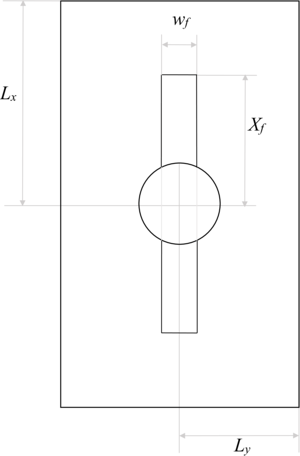
A production well located in the centre of a reservoir of dimensions is simulated. The well is hydraulically fractured with a half‑length
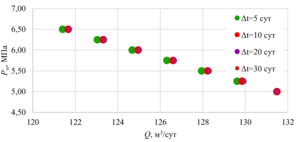
For the constant‑pressure boundary case, it is established that the duration of the test steps does not significantly affect the interpretation results nor the quality of fitting the pressure‑rate relationship (coefficient of determination ). The only exception is the stage duration of 5 days, which shows the largest deviation. This is consistent with conventional understanding: increasing the duration of each step in a step‑rate test improves interpretation accuracy because a linear relationship between bottomhole pressure and flow rate is valid under steady‑state flow conditions.
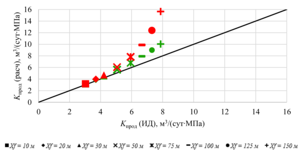
Analysis of productivity indices for different hydraulic fracture half‑lengths (10-150 m) shows that the classical formulas of Economides (for finite‑conductivity fractures) and Prats (for infinite‑conductivity fractures) agree well with reference values over a certain range of fracture lengths. For very long fractures, deviations appear because the fracture approaches the reservoir boundary, distorting the classical analytical solutions.
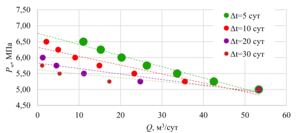
For the no‑flow (closed) boundary case: In a closed system (impermeable reservoir boundaries), fluid withdrawal causes a continuous decline in average reservoir pressure. Consequently, the IPR deviates from linearity, indicating unsteady‑state (transient) flow. It is important to emphasise that under such conditions, the traditional interpretation of step‑rate tests using the steady‑state IPR method becomes invalid - it leads to systematic errors in evaluating well productivity and other reservoir parameters. A similar situation can arise due to interference from neighbouring wells or in areas with a dense well spacing, where conditions approach those of a closed reservoir. Therefore, when planning tests in closed reservoirs or dense well patterns, special interpretation techniques adapted to transient flow should be used (e.g., rate‑transient analysis, multi‑well deconvolution). Observed non‑linearity of the IPR may serve as an indication of the absence of support from adjacent injectors, the presence of non‑linear flow, or the presence of no‑flow boundaries.
Conclusion
Based on numerical simulation of step‑rate well tests, it is found that in closed systems, prolonged step durations lead to non‑linear distortion of the IPR. This is caused by the continuous decline in average reservoir pressure. Under such conditions, the conventional steady‑state interpretation of the IPR becomes incorrect. It is shown that increasing the step duration under no‑flow boundary conditions amplifies the deviation from linearity, thereby reducing the reliability of productivity estimates. The obtained results should be taken into account when planning and interpreting IPR‑based step‑rate well tests in low‑permeability reservoirs, as well as in areas with dense well spacing, non‑linear flow regimes in low‑permeability reservoirs, etc. In such cases, it is advisable to apply interpretation methods adapted to transient conditions (e.g., rate‑transient analysis considering reservoir boundaries, multi‑well deconvolution).
References
- Карнаухов МЛ, Пьянкова ЕМ. Современные методы гидродинамических исследований скважин. Справочник инженера по исследованию скважин. Вологда: Инфра-Инженерия. 2010. 432 с.
Karnaukhov ML, Pyankova EM. Modern Methods of Hydrodynamic Well Testing: A Handbook for Well Testing Engineers. Vologda: Infra-Inzheneriya. 2010. 432 p. (in Russian) - Эрлагер Р. Гидродинамические методы исследования скважин. М.–Ижевск: Институт компьютерных исследований, 2007. 512 с.
Erlager R. Hydrodynamic Well Testing Methods. Moscow–Izhevsk: Institute of Computer Science Research, 2007. 512 p. (in Russian) - Давлетбаев АЯ, Асалхузина ГФ, Уразов РР, Сарапулова ВВ. Гидродинамические исследования скважин в низкопроницаемых коллекторах. Новосибирск: ООО «ДОМ МИРА». 2023. 176 с.
Davletbaev A.Ya., Asalkhuzina G.F., Urazov R.R., Sarapulova V.V. Hydrodynamic Well Testing in Low-Permeability Reservoirs. Novosibirsk: DOM MIRA LLC. 2023. 176 p. - Асалхузина ГФ, Бикметова АР, Кардопольцев АС, и др. Эволюция методов и масштабов гидродинамических исследований низкопроницаемых коллекторов. Нефтяное хозяйство. 2023;(9):108–111.
https://doi.org/10.24887/0028-2448-2023-9-108-111
Asalkhuzina GF, Bikmetova AR, Kardopoltsev AS. Evolution of Methods and Scopes of Welltesting on Fields with Low Permeability Reservoir. Oil Industry Journal. 2023;(9):108–111. (in Russian) - Асалхузина ГФ, Давлетбаев АЯ, Хабибуллин ИЛ, Ахметова РР. К вопросу выбора длительности режимов при гидродинамических исследованиях скважин на установившихся режимах закачки в низкопроницаемых коллекторах. Вестник Тюменского государственного университета. Физико-математическое моделирование. Нефть, газ, энергетика. 2020;6(1):135–149.
https://doi.org/10.21684/2411-7978-2020-6-1-135-149
Asalkhuzina GF, Davletbaev AYa, Khabibullin IL, Akhmetova RR. On the selection of suitable operate durations for injection tests in low permeability reservoirs. Tyumen State University Herald. Physical and Mathematical Modeling. Oil, Gas, Energy. 2020;6(1):135–149. (in Russian) - Давлетбаев АЯ. Фильтрация жидкости в пористой среде со скважинами с вертикальной трещиной гидроразрыва пласта. Инженерно-физический журнал. 2012;85(5):919–924. https://elibrary.ru/pbxaqt
Davletbaev AYa. Fluid flow in a porous medium with wells containing a vertical hydraulic fracture. Journal of Engineering Physics and Thermophysics. 2012;85(5):919–924. (in Russian) - Сарапулова ВВ, Давлетбаев АЯ, Кунафин АФ, и др. Программный комплекс «РН-ВЕГА» для анализа и интерпретации результатов гидродинамических исследований скважин. Нефтяное хозяйство. 2023;(12):124–129. https://doi.org/10.24887/0028-2448-2023-12-124-129
Sarapulova VV, Davletbayev AYa, Kunafin AF. The RN-VEGA program complex for well test analysis and interpretation. Oil Industry Journal. 2023;(12):124–129. (in Russian) - Cinco-Ley H, Samaniego VF. Transient pressure analysis for fractured wells. J. Petrol. Technol. 1981;33(9):1749–1766.
https://doi.org/10.2118/7490-PA - Нагаева ЗМ, Шагапов ВШ. Об упругом режиме фильтрации в трещине, расположенной в нефтяном или газовом пласте. Прикл. математика и механика. 2017;81(3):319–329. https://elibrary.ru/yspcjl
Nagaeva ZM, Shagapov VS. Elastic seepage in a fracture located in an oil or gas reservoir. Journal of Applied Mathematics and Mechanics. 2017;81(3):214–222. https://doi.org/10.1016/j.jappmathmech.2017.08.013 - Хабибуллин ИЛ, Хисамов АА. К теории билинейного режима фильтрации в пластах с трещинами гидроразрыва. Вестник Башкир. Университета. 2018;23(4):958–963. https://elibrary.ru/yuxnqt
Khabibullin IL, Khisamov AA. On the Theory of Bilinear Flow Regime in the Layers With Hydraulic Fracturing Cracks. Bulletin of Bashkir University. 2018;23(4):958–963. (in Russian) - Хабибуллин ИЛ, Хисамов АА. Нестационарная фильтрация в пласте с трещиной гидроразрыва пласта. Изв. РАН. Механика жидкости и газа. 2019;(5):6–14. https://doi.org/10.1134/S0568528119050050
Khabibullin IL, Khisamov, AA. Unsteady Flow through a Porous Stratum with Hydraulic Fracture. Fluid Dyn. 2019;54:594–602.
https://doi.org/10.1134/S0015462819050057 - Prats M. Effect of Vertical Fractures on Reservoir Behavior-Incompressible Fluid Case. SPE J. 1961;1(02):105–118.
https://doi.org/10.2118/1575-G - Economides M, Oligney R, Valko P. Unified Fracture Design: Bridging the Gap Between Theory and Practice. Alvin, Texas: Orsa Press. 2001. 262 p.
- Ипатов АИ, Кременецкий МИ. Долговременный мониторинг промысловых параметров, как знаковое направление развития современных ГДИС. Инженерная практика. 2012;(9):4–8. https://elibrary.ru/anrpty
Ipatov AI, Kremenetsky MI. Long-term monitoring of production parameters as a key trend in the development of modern well testing systems. Engineering Practice. 2012;(9):4–8. (in Russian) - Гуляев ДН, Батманова ОВ, Даниленко ОИ. Применение мультискважинной деконволюции для анализа свойств нефтяных пластов. Вестник Российского нового университета. Серия: Сложные системы: модели, анализ и управление. 2019;(3):81–92.
https://doi.org/10.25586/RNU.V9187.19.03.P.081
Gulyaev DN, Batmanova OV, Danilenko OI. Multi-Well Deconvolution Method Implementation for Oil Reservoir Characterization. Vestnik of the Russian New University. Series “Complex Systems: models, analysis and management”. 2019;(3):81–92. (in Russian) - Cumming JA, Wooff DA, Whittle T, Gringarten AC. Multiwell Deconvolution. SPE Res Eval \& Eng. 2014;17(04):457–465. https://doi.org/10.2118/166458-PA
- Асалхузина ГФ, Давлетбаев АЯ, Хабибуллин ИЛ. Моделирование дифференциации пластового давления между нагнетательными и добывающими скважинами на месторождениях с низкопроницаемыми коллекторами. Вестник Башкирского университета. https://elibrary.ru/wyofxl
Asalkhuzina GF, Davletbaev AY, Habibullin IL. Modeling of the Reservoir Pressure Difference Between Injection and Production Wells in Low Permeable Reservoirs. Bulletin of Bashkir University. 2016;21(3):537–544. (in Russian) - Байков ВА, Галеев РР, Колонских АВ, Якасов АВ, Торопов КВ. Нелинейная фильтрация в низкопроницаемых коллекторах. Влияние на технологические показатели разработки месторождения. Научно-технический вестник «НК „Роснефть“». 2013;(2):17–19.
https://elibrary.ru/RVWTIH
Baykov VA, Galeev RR, Kolonskikh AV, Yakasov AV, Toropov KV. Non-linear flow in low-permeability reservoirs: impact on field development performance indicators. Scientific and Technical Bulletin of Rosneft. 2013;(2):17–19. (in Russian) - Кокурина ВВ, Кременецкий МИ, Кричевский ВМ. Контроль эффективности повторного гидроразрыва пласта по результатам гидродинамических исследований. Каротажник. 2013;(5(227)):76–99. https://elibrary.ru/qaaljn
Kokurina VM, Kremenetsky MI, Krichevsky VM. Rehydrofrac Effectiveness Control by Hydrodynamical Surveys. Karotazhnik. 2013;(5(227)):76–99. (in Russina)